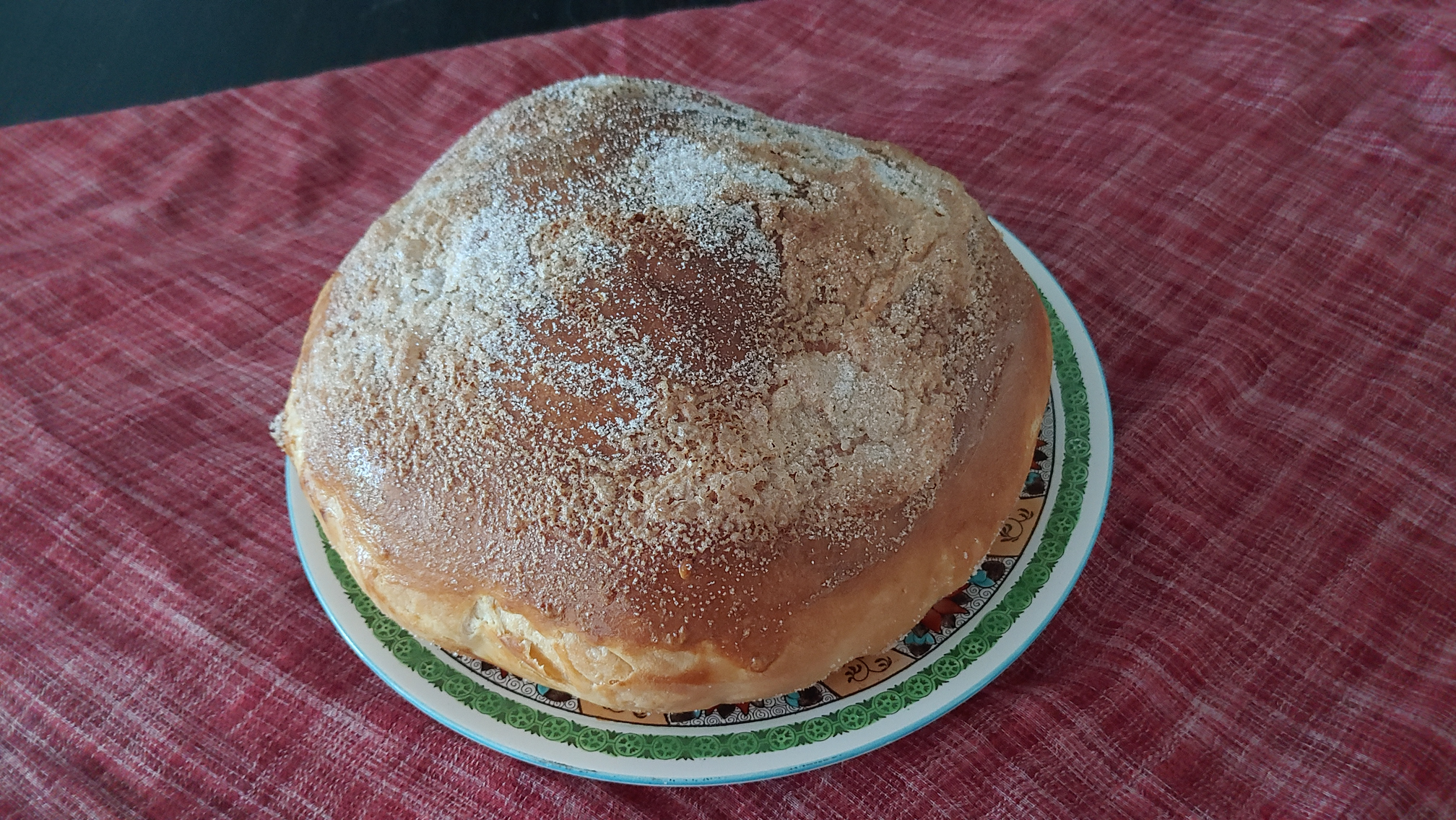
This is a slightly adapted version of a recipe redaction I created for the 2024 Kingdom of Ealdormere Cooks’ Calendar.
Table of Contents
To make a layered round pizza in another way, cooked in the oven on card. Take two pounds of flour and make a dough with warm water, salt and an ounce of a half of leavening mixed with warm water, and three ounces of fresh butter, and blend it together so that it is neither to wet nor too dry. Let it rest under a white cloth in warm place until it is risen, as one does for bread. And knead it another time on the table, adding as little flour as possible when one kneads. And have ready two pounds of fresh butter, divided into pieces as large as a hazelnut, the said butter having soaked in cold water and then transferred to rose water. Take the pastry and with the palm of the hand, or with a pastry roller, and make it round like a table cloth, in the way that it stays about the width of a knife handle. Then take the butter pieces and put them, one at a time, on top of the pastry, leaving a space about a fingers width around the edge of the pasta empty. This empty space one will bathe with beaten egg. Fold the sheet over the butter, over and over again, from all angles. Make it in such a way that this sheet becomes like the head gear of a priest, that is one brings together the parts bathed in egg, and with the hand shapes it in such as way that it becomes round. And very slowly one begins to push it, being careful not to break the pastry, do this so that it returns to its previous size and shape as at first. And this one does more times, until one has used all the butter, and it is worked to the shape of a small bun. Have already prepared a sheet of thick paper, greased with butter on one side, and put above it the pastry with the turnings and layers below, make it such that the smooth side faces above. And give it color with a beaten egg and put in the oven, and it should not be too hot, and as a general rule at the bottom (lowest temperature), and when it begins to rise so that it doesn’t get too dark one covers it with a piece of torn paper and let it finish cooking. And when it is cooked, in all weathers it should be served hot. […] And also if one wants to give it color, when it is nearly cooked brush with egg yolk and powder with sugar. (Book V, recipe 132).
Scully, T. (2008) The Opera of Bartolomeo Scappi (1570): L’arte et prudenza d’un maestro cuoco (The Art and Craft of a Master Cook). Toronto, ON, Canada: University of Toronto Press.
Some brief notes on technique
A Renaissance cook would most likely have relied on either sourdough or old dough (that is, dough kept from a previous day’s baking) to provide leavening. I don’t bake enough to keep a sourdough culture going, and I was redacting this for an audience who would most likely be starting from scratch, so I decided to compromise by using a limited amount ofpackaged baker’s yeast and some extra fermentation time.
On a very lightly floured surface. roll the dough into a 50cm circle. Scatter 1/4 of the diced butter over the dough, leaving a clear 3cm margin around the edges. Brush the edges well with beaten egg. Fold four sides inward so that the brushed edges come together forming an X (like a priest’s biretta), or use an envelope fold to enclose the butter. Whichever method you use, be sure that the edges are well sealed. Carefully, so as not to break the layers, shape it back into a disc. If it contains any large bubbles, you can prick the dough and let the air out, carefully sealing the puncture afterwards.
With the same side of the pizza facing up, repeat step 3 three more times. Then, roll and fold twice more without adding any more butter. You will find that it becomes harder to roll out without breaking layers as you go, so, while your first roll-out should be about 50cm in diameter, you can gradually decrease to 30cm on the last.
Turn the dough folded-side down and flatten it into a 20cm disc. Put this into a 23cm pie dish lined with baker’s parchment, cover, and allow to rise at room temperature until doubled in size (about 2-1/2 hours).
Preheat the oven to 225C. Brush the top of the pizza with beaten egg and put into the oven. Lower the temperature to 190C. Bake 40 minutes, then take it out, give it another coat of beaten egg and sprinkle with sugar. Bake 5 more minutes, then carefully transfer to a cooling rack.
Astute observers will note that I have reduced the ratio of butter to dough somewhat. I found that it was simply impossible to keep as much butter as Scappi suggests in the pizza without it leaking away during baking. I also left out soaking my butter in rosewater, which I found make a negligible difference to flavour.
My recipe
- 1/2 tsp yeast
- 1/2 c all-purpose flour, sifted
- 1/4 c warm water
- 1/2 tsp sugar
Combine the water, yeast, flour, and sugar. Cover with a damp tea towel or clingfilm and allow it to rise in a warm place until at least tripled in bulk (about one hour).
- 2-1/2 c all-purpose flour, sifted
- 3/4 c cake flour, sifted
- 3/4 c plus 1 tbsp. warm water
- 1-1/2 oz butter, at room temperature
- 1-1/2 tsp salt
Combine these ingredients plus the dough from the first step. This is a fairly dry dough; if it doesn’t quite come together, add 1-2 Tbsp additional water. Knead ’til smooth and elastic (about 250 strokes or 2 min on medium low with a stand mixer). Put the dough in a lightly buttered bowl, cover, and let it rise in a warm place ’til doubled in bulk (about 90 minutes).
- 1 egg, beaten
- 225g cold, unsalted butter, in 5-6mm dice.
- 2 tbsp. sugar
On a very lightly floured surface. roll the dough into a 50cm circle. Scatter 1/4 of the diced butter over the dough, leaving a clear 3cm margin around the edges. Brush the edges well with beaten egg. Fold four sides inward so that the brushed edges come together forming an X (like a priest’s biretta), or use an envelope fold to enclose the butter. Whichever method you use, be sure that the edges are well sealed. Carefully, so as not to break the layers, shape it back into a disc. If it contains any large bubbles, you can prick the dough and let the air out, carefully sealing the puncture afterwards.
With the same side of the pizza facing up, repeat step 3 three more times. Then, roll and fold twice more without adding any more butter. You will find that it becomes harder to roll out without breaking layers as you go, so, while your first roll-out should be about 50cm in diameter, you can gradually decrease to 30cm on the last.
Turn the dough folded-side down and flatten it into a 20cm disc. Put this into a 23cm pie dish lined with baker’s parchment, cover, and allow to rise at room temperature until doubled in size (about 2-1/2 hours).
Preheat the oven to 225C. Brush the top of the pizza with beaten egg and put into the oven. Lower the temperature to 190C. Bake 40 minutes, then take it out, give it another coat of beaten egg and sprinkle with sugar. Bake 5 more minutes, then carefully transfer to a cooling rack.
On a very lightly floured surface. roll the dough into a 50cm circle. Scatter 1/4 of the diced butter over the dough, leaving a clear 3cm margin around the edges. Brush the edges well with beaten egg. Fold four sides inward so that the brushed edges come together forming an X (like a priest’s biretta), or use an envelope fold to enclose the butter. Whichever method you use, be sure that the edges are well sealed. Carefully, so as not to break the layers, shape it back into a disc. If it contains any large bubbles, you can prick the dough and let the air out, carefully sealing the puncture afterwards.
With the same side of the pizza facing up, repeat step 3 three more times. Then, roll and fold twice more without adding any more butter. You will find that it becomes harder to roll out without breaking layers as you go, so, while your first roll-out should be about 50cm in diameter, you can gradually decrease to 30cm on the last.
Turn the dough folded-side down and flatten it into a 20cm disc. Put this into a 23cm pie dish lined with baker’s parchment, cover, and allow to rise at room temperature until doubled in size (about 2-1/2 hours).
Preheat the oven to 225C. Brush the top of the pizza with beaten egg and put into the oven. Lower the temperature to 190C. Bake 40 minutes, then take it out, give it another coat of beaten egg and sprinkle with sugar. Bake 5 more minutes, then carefully transfer to a cooling rack.


